Understanding how steel materials are processed in factories requires more than watching molten metal become solid bars. It involves chemistry, heat control, forming pressure, cooling speed, and repeated inspection. In a modern steel plant, iron-bearing materials enter a furnace, where temperatures can exceed 1,500°C. Operators monitor carbon levels and impurities through laboratory testing and digital sensors. Small variations matter. They can change strength, hardness, weldability, and surface quality.
Materials scientist George Krauss described steel as “an alloy of iron and carbon containing less than about 2% carbon.” This simple definition hides a complicated manufacturing journey. After refining, the liquid steel moves into continuous casting equipment. Water-cooled molds shape it into slabs, blooms, or billets. Rollers then reduce the material’s thickness or diameter. Some products receive controlled heat treatment, pickling, coating, or precision cutting. Each stage leaves visible clues, from red-hot surfaces to scale marks and polished edges.
Reliable factories do not trust appearance alone. Technicians use ultrasonic testing, dimensional gauges, tensile tests, and visual inspections. Traceable records connect each batch to its furnace chemistry and processing history. That discipline supports safer construction, transportation, energy, and machinery applications. Still, no process is perfect. A clean surface may conceal internal stress. A strong result may become brittle after poor cooling. This is why experienced engineers review data, question unusual readings, and adjust production carefully. The best explanation of how steel materials are processed in factories includes both scientific control and practical judgment. Mistakes can teach, but they should never become routine.
Modern steel production begins long before molten metal reaches the furnace. Raw materials may include iron ore, recycled scrap, coke, limestone, and carefully selected alloys. Each delivery is sampled and tested for chemistry, moisture, size, and unwanted elements. A small variation can affect furnace stability and final strength.
In the raw-material yard, magnets, screens, and loaders separate and prepare different materials. Scrap is sorted by grade and checked for sealed containers or other safety risks. Iron ore is crushed, blended, and formed into suitable feed for the furnace. Limestone and other fluxes help remove impurities during melting. Accurate weighing matters. Poor batching can create uneven heat and chemical composition.
Preparation also includes equipment checks, storage control, and traceable records. Covered areas protect materials from rain, while sensors monitor temperature and stock levels. Workers compare laboratory results with production data before charging the furnace. Errors still happen. A damp load, a mislabeled bin, or rushed inspection can disrupt an entire shift. This is why experienced teams review abnormal readings instead of trusting automatic systems blindly. The process looks highly controlled, but it still depends on careful judgment, clean sampling, and disciplined maintenance.
In Chinese steel factories, processing starts with measured ore, scrap, flux, and fuel. Operators check moisture, size, and impurity levels before charging the furnace. The World Steel Association’s World Steel in Figures 2024 reports that China produced 1,019.1 million tonnes of crude steel in 2023. That scale demands disciplined control. Small errors multiply quickly.
In a basic oxygen furnace, oxygen removes carbon from molten iron. Electric arc furnaces melt scrap through controlled electrical energy. Refiners then adjust temperature, slag chemistry, and oxygen activity. Argon stirring helps distribute alloying elements through the bath. Vacuum treatment can reduce dissolved hydrogen and nitrogen. Samples are tested with optical emission spectrometers. Technicians compare carbon, manganese, silicon, sulfur, phosphorus, chromium, and nickel against the grade specification.
Chemical control is not only a laboratory task. Experienced workers watch sparks, slag movement, tapping temperature, and sample trends. The OECD’s 2024 Steel Outlook highlights continuing pressure to improve efficiency and reduce production emissions across the steel sector. Better control can reduce rework, energy loss, and rejected heats. Still, one test sample may not represent the entire ladle. That weakness deserves attention. Sensors drift, samples cool unevenly, and rushed adjustments can create new problems. Reliable plants therefore combine automated records with repeated sampling and trained judgment. Chemistry is precise, but factory conditions remain imperfect.
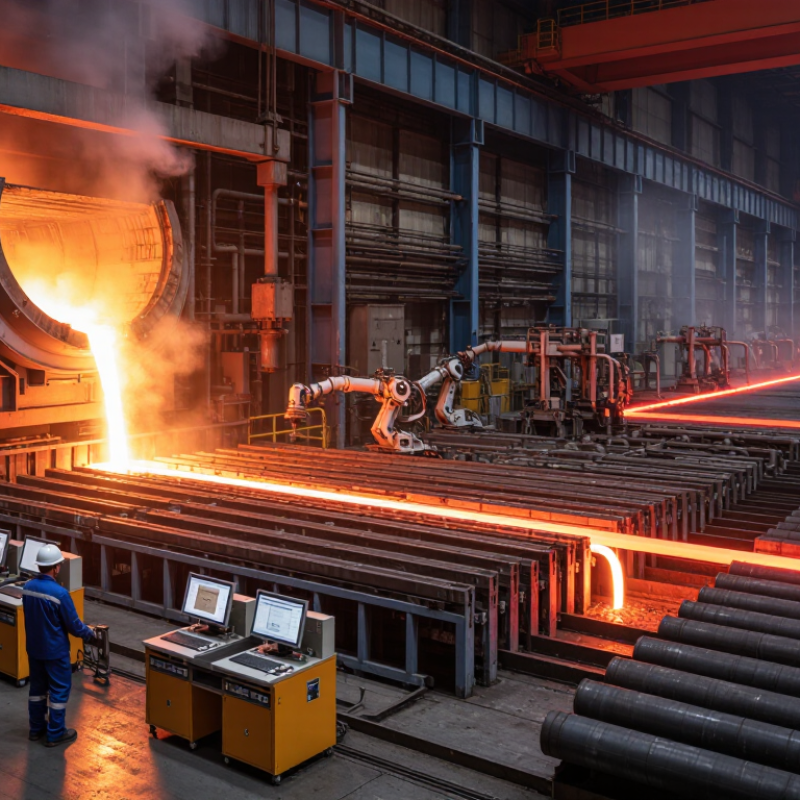
In modern steel factories, liquid steel leaves a ladle at temperatures above 1,500°C. It flows into a tundish, which balances the stream before it reaches the water-cooled copper mold. The mold shapes the steel while controlled water removes heat from its surface. Oscillation prevents the shell from sticking.
The emerging strand enters a secondary cooling zone. Fine water sprays strengthen the shell and control internal stresses. Rollers guide the strand through bending and straightening equipment. Cutting machines then produce slabs, blooms, or billets at precise lengths.
Slabs are wide and relatively thin for flat products.
Blooms are larger, often square or rectangular,
while billets have smaller sections for bars and wire products.
Temperature sensors, mold-level controls, and visual inspections help operators detect cracks, segregation, and uneven surfaces. Small changes matter.
Tips: Keep pouring speed stable, monitor mold lubrication, and check spray patterns regularly. Record every adjustment. It supports traceability and future troubleshooting.
In practice, no cast is perfectly uniform. Steel chemistry, cooling intensity, and equipment wear can interact unexpectedly. A rushed correction may reduce one defect while creating another. Experienced teams compare sensor data with surface observations before changing settings. This human judgment remains important, although it is not infallible. During production, samples are tested for composition and internal soundness, helping confirm that each semi-finished section meets its intended processing requirements.
China Top: How Steel Materials Are Processed in Factories?
Heating, Rolling, and Shaping Steel Products
China produced about 1.019 billion metric tons of crude steel in 2023, according to World Steel Association data. That represented roughly 54% of global output. Factory processing begins after molten steel is cast into slabs, billets, or blooms. Reheating furnaces usually raise the material above 1,100°C before rolling. At this temperature, steel becomes easier to compress and reshape. Large rollers reduce thickness, control width, and create plates, bars, or coils. Sensors measure temperature, speed, and pressure during every pass. A small error can affect surface quality.
Tips: Check furnace temperature, roller alignment, and cooling speed together. One measurement is not enough. The International Energy Agency reports that steelmaking creates about 8% of global energy-related emissions. Efficient heating and waste-heat recovery therefore matter. After hot rolling, some products receive controlled cooling to improve strength and toughness. Cold rolling may follow, producing smoother surfaces and tighter dimensions. Cutting, straightening, welding, and forming then prepare steel for construction, vehicles, machinery, and appliances.
In practice, no production line is perfectly stable. Steel may cool unevenly near its edges. Operators must inspect samples and adjust pressure or speed. World Steel Association sustainability reports also show that energy use and emissions remain major industry concerns. Electric furnaces, recycled scrap, and cleaner electricity can reduce impacts, but results depend on the local power system. Good processing is not only fast. It is measured, inspected, and occasionally corrected.
| Process Stage | Primary Purpose | Typical Equipment | Typical Operating Range | Main Material Changes | Common Products | Key Quality Controls |
|---|---|---|---|---|---|---|
| Raw Material Preparation | Prepare iron-bearing materials and recycled steel for efficient melting and refining. | Raw-material yards, conveyors, weighing systems, sinter plants, pelletizing units, and scrap preparation equipment. | Material size commonly controlled to approximately 5–50 mm, depending on the process route. | Iron ore fines may be agglomerated into sinter or pellets; scrap is sorted, cut, and compacted when necessary. | Sinter, iron ore pellets, prepared steel scrap, and metallurgical additives. | Chemical composition, moisture, particle size, contamination, and material weight. |
| Ironmaking | Produce molten iron or direct-reduced iron for steelmaking. | Blast furnaces or direct-reduction reactors with hot-blast stoves and gas-treatment systems. | Blast-furnace raceway temperatures can exceed 2,000°C; molten iron is commonly discharged at about 1,400–1,500°C. | Iron oxides are reduced, and unwanted gangue materials combine with fluxes to form slag. | Hot metal or direct-reduced iron. | Iron content, carbon level, silicon, sulfur, temperature, slag chemistry, and production rate. |
| Steelmaking | Convert molten iron and/or scrap into liquid steel with a controlled chemical composition. | Basic oxygen furnaces, electric arc furnaces, oxygen lances, electrodes, and furnace control systems. | Liquid steel is generally tapped at approximately 1,600–1,700°C. | Carbon and impurity levels are reduced; alloying elements may be added to achieve the required grade. | Refined liquid carbon steel, low-alloy steel, and stainless steel melts. | Carbon, manganese, silicon, phosphorus, sulfur, dissolved gases, temperature, and sample analysis. |
| Secondary Metallurgy | Fine-tune steel chemistry, temperature, cleanliness, and inclusion control before casting. | Ladle furnaces, vacuum degassing units, argon stirring systems, and alloy-feeding equipment. | Treatment temperature is typically maintained within the liquid-steel range, often about 1,550–1,650°C. | Alloy composition is adjusted, dissolved hydrogen and nitrogen may be reduced, and nonmetallic inclusions are floated or modified. | Clean, composition-controlled liquid steel ready for casting. | Temperature uniformity, alloy recovery, oxygen activity, hydrogen content, inclusion population, and ladle condition. |
| Continuous Casting | Solidify liquid steel into semi-finished shapes with consistent dimensions. | Tundishes, water-cooled copper molds, secondary cooling zones, withdrawal units, straighteners, and cutting machines. | Steel enters the mold near its casting temperature; strand surface cooling uses controlled water sprays. | Liquid steel forms a solid shell in the mold and gradually becomes a solid slab, billet, or bloom. | Slabs, billets, blooms, and beam blanks. | Slab or billet dimensions, casting speed, mold level, shell thickness, surface cracks, internal defects, and temperature. |
| Reheating | Heat semi-finished steel uniformly before hot rolling. | Walking-beam furnaces, pusher furnaces, burners, recuperators, and furnace-temperature monitoring systems. | Many carbon-steel products are reheated to approximately 1,100–1,250°C, depending on grade and product size. | The steel becomes sufficiently ductile for deformation; excessive oxidation and grain growth must be controlled. | Hot-rolling feedstock for plates, strips, bars, wire rod, rails, and sections. | Furnace temperature profile, heating uniformity, scale formation, soaking time, fuel efficiency, and surface condition. |
| Roughing Rolling | Reduce thickness and break down the cast structure through high-force deformation. | Reversing mills, roughing stands, vertical edgers, and descaling systems. | Hot-rolling deformation commonly begins above 900°C, with the exact range determined by steel grade and product route. | Thickness decreases, length increases, and the cast microstructure is refined through deformation and recrystallization. | Transfer bars, intermediate slabs, blooms, and billets. | Rolling force, reduction per pass, width control, temperature drop, flatness, and dimensional accuracy. |
| Finishing Rolling | Achieve final hot-rolled dimensions, shape, surface quality, and selected mechanical properties. | Continuous finishing mills, universal stands, edgers, descaling units, and automatic gauge-control systems. | Finishing temperatures vary by product; controlled rolling may finish near or above the steel grade’s transformation range. | Final thickness and profile are established; controlled deformation can refine grains and improve strength. | Hot-rolled coil, hot-rolled plate, bars, wire rod, rails, and structural sections. | Thickness, width, crown, flatness, profile, surface scale, temperature, and dimensional tolerances. |
| Controlled Cooling | Control the cooling rate to obtain the required microstructure and mechanical properties. | Laminar cooling systems, water headers, air-cooling beds, run-out tables, and cooling-control software. | Cooling rates depend on grade and product; water flow, cooling-zone length, and final coiling temperature are controlled. | Austenite transforms into ferrite, pearlite, bainite, or other intended structures depending on chemistry and cooling conditions. | Thermomechanically processed plate, strip, bar, and structural products. | Cooling rate, final cooling temperature, temperature uniformity, tensile strength, yield strength, and toughness. |
| Coiling or Cutting | Convert continuously rolled material into manageable coils or ordered lengths. | Coilers, crop shears, flying shears, hot saws, cooling beds, and bundling machines. | Coiling temperature is selected according to steel grade, thickness, and target microstructure. | Strip is wound into coils, while plate, bar, billet, and section products are cut to specified lengths. | Hot-rolled coils, cut-to-length plate, bars, billets, and structural sections. | Coil shape, end condition, length, weight, edge quality, burrs, and surface defects. |
| Descaling and Surface Treatment | Remove oxide scale and prepare the surface for further processing or delivery. | High-pressure water descalers, shot-blasting machines, pickling lines, rinsing units, and drying systems. | High-pressure descaling commonly uses water pressures of roughly 150–300 bar; pickling conditions depend on acid concentration and temperature. | Oxide scale is mechanically or chemically removed; the steel surface becomes cleaner and more uniform. | Descaled plate, pickled strip, cold-rolling feedstock, and finished structural products. | Residual scale, surface roughness, acid concentration, over-pickling, edge condition, and corrosion protection. |
| Cold Rolling | Improve dimensional accuracy and surface finish while increasing strength through controlled deformation. | Pickling lines, tandem cold mills, reversing mills, roll-coating systems, and tension-leveling equipment. | Processing occurs near room temperature; reduction may range from moderate to more than 50%, depending on grade and application. | Thickness is reduced without reheating; the material becomes work-hardened and may require annealing. | Cold-rolled sheet, strip, and precision steel products. | Thickness, width, flatness, surface roughness, rolling force, elongation, and dimensional tolerances. |
| Heat Treatment | Adjust hardness, ductility, strength, toughness, and residual stress. | Continuous annealing lines, batch annealing furnaces, quench tanks, tempering furnaces, and normalizing furnaces. | Temperature varies widely by grade and treatment; many annealing processes operate approximately between 600°C and 850°C. | Recovery, recrystallization, phase transformation, precipitation, or stress relief changes the steel’s microstructure. | Annealed sheet, normalized plate, quenched-and-tempered plate, and heat-treated bars. | Heating rate, soaking time, cooling rate, hardness, tensile properties, grain size, and residual stress. |
| Shaping and Section Forming | Produce final geometries such as tubes, beams, channels, angles, rails, and formed sheet components. | Section mills, roll-forming lines, tube mills, presses, forging equipment, and bending machines. | Hot shaping may occur above the recrystallization range; cold forming is normally performed near room temperature. | Flat or semi-finished steel is bent, pressed, forged, welded, or rolled into a defined profile. | Structural sections, pipes, tubes, channels, angles, rails, and formed components. | Profile geometry, wall thickness, straightness, weld integrity, dimensional tolerances, and forming defects. |
| Finishing and Inspection | Meet customer specifications and confirm that the product is safe and fit for service. | Levelers, grinders, straighteners, ultrasonic testing systems, eddy-current testers, laser gauges, and laboratory equipment. | Inspection is performed at ambient conditions unless a specified test requires controlled temperature. | Minor surface imperfections may be removed; products are straightened, marked, tested, and prepared for shipment. | Certified steel plates, coils, bars, wire rod, pipes, tubes, and structural products. | Chemical analysis, tensile test, impact test, hardness, ultrasonic inspection, surface inspection, dimensions, and traceability. |
| Note: Operating temperatures, reduction levels, cooling rates, and inspection requirements are representative industrial ranges. Actual values vary according to steel grade, product thickness, equipment design, production route, and applicable standards. | ||||||
Steel materials made in China pass through several controlled stages before shipment. After cutting and forming, workers remove burrs, oil, and surface scale. Grinding leaves a smoother edge, while shot blasting prepares the surface for protective coating. Operators check coating thickness with calibrated gauges. Small uneven areas still appear sometimes, so rework is necessary.
Quality testing combines visual inspection with measurable data. Technicians verify dimensions using micrometers, gauges, and coordinate measuring equipment. They may test tensile strength, hardness, chemical composition, and weld quality. Each batch receives traceable records, including heat numbers and inspection results. In practice, paperwork can contain mistakes. A second review helps prevent incorrect certificates from reaching customers.
Tips: Ask for material certificates, test standards, and packaging photos before production ends. Confirm whether testing is performed internally or by an independent laboratory. Factory packaging should match the transport route and storage period. Steel is commonly wrapped with moisture-resistant material, separated by spacers, and secured with steel or plastic straps. Desiccants may be added for long sea shipments. Sharp edges need protection. Otherwise, finished surfaces can be damaged before arrival.
Common materials include iron ore, recycled scrap, coke, limestone, and selected alloys. Each delivery is sampled before use.
Magnets, screens, and loaders sort materials by type and size. Iron ore may be crushed, blended, and formed into suitable feed.
Correct weighing supports stable heat and consistent chemistry. Poor batching can produce uneven composition and weaker results.
Scrap is sorted by grade and inspected for sealed containers or other hazards. A rushed inspection can still miss something.
Liquid steel flows through a tundish into a water-cooled copper mold. The mold creates the initial shell and shape.
Slabs are wide and relatively thin. Blooms have larger sections, while billets are smaller and suit bars or wire products.
Sensors monitor temperature and mold level. Operators also inspect surfaces for cracks, segregation, and uneven areas.
Reheating furnaces raise the steel above 1,100°C. Rollers then reduce thickness, control width, and create plates, bars, or coils.
Controlled cooling can improve strength and toughness. Sampling helps detect uneven edges, surface problems, or dimensional errors.
Not completely. Equipment wear, damp materials, and changing cooling conditions can disrupt production. Human judgment still matters, but it can fail.
Understanding how steel materials are processed in factories begins with selecting and preparing raw materials such as iron-bearing materials, recycled steel, and alloying elements. These inputs are melted in high-temperature furnaces, then refined to remove impurities and adjust the chemical composition according to the intended application. Careful monitoring during this stage helps ensure consistent strength, hardness, and performance.
After refining, liquid steel is cast into semi-finished forms, including slabs, blooms, and billets. These shapes are reheated and passed through rolling equipment to produce plates, sheets, bars, beams, tubes, and other products. The final stages may include cutting, surface treatment, straightening, and dimensional correction. Factories then conduct quality tests to check composition, size, surface condition, and mechanical properties before packaging and shipment. Through controlled processing at every step, modern steel factories transform raw materials into reliable products for construction, transportation, manufacturing, and many other industries.

Sandstorm Steel